Wednesday, 23 December 2009

Televised debates


The three main party leaders announced yesterday that before the general election (which most pundits believe will happen on May 6th 2010) three ninety minute TV debates will take place, with Sky the BBC and ITV each assuming hosting responsibilities. The academic Bill Jones, who works tirelessly in politics education, offers his comments here..

It is perhaps worth noting what this means for Prime Ministerial politics in the UK. Let's start with theory. The 'Prime Minister' was a role introduced in the 18th century to help the Monarch with his duties, i.e., Robert Walpole was appointed by George II because of the widening role of government. Indeed, even in the era of the 'fiscal military state' it was felt that a specialist full time role needed to be created.

During the democratic advances of the nineteenth century, the 'Prime Minister' (as he became known, only officially, in the 1880s - hitherto it had been a term of abuse and mocking. PMs had gone by the title 'First Lord of the Treasury', which is still emblazoned on the letterbox of Number 10) became primus inter pares or 'first among equals' as cabinet government developed. However, even as he assumed greater power and responsiblity in the 1900s, rising above his cabinet ministers and wielding the power to make or break a career, he was still merely the leader of the party with the most seats in the Commons. In theory that's all he or she is today...

However, in our media age things have taken on a slightly more Presidential edge. Presidents, as we know, are much more powerful than PMs because of their dual role as head of the government and the state. At a time when image had become more important and ideology less of a sticking point, our leaders have taken on this role with gusto. Thatcher made inroads in the later 1980s when her tenure became increasingly authoritarian (this 'taking power for granted' approach cost her dearly in November 1990). She behaved more like a Head of State than a lowly Prime Minister and earned the ill will of the sovereign, her party and the people as a result. New Labour's fascination with spin and image manipulation has seen Blair and Brown behave more like Presidents than Prime Ministers. Now, we are going to have 'Leader's Debates' in the run up to the election. What does this mean - effectively we are being asked to vote for individuals (like Americans voted for Obama or McCain in 2008). However, in reality we still vote for a local MP. Those less in tune with with how our democracy works may be fooled into thinking that they will vote for the face that most appeals to them on the television screen. The reality is that they will be voting for a candidate in their local area. Only if candidates of the same party are returned to Westminster in large numbers next year can any one of those three faces stand any chance of forming a government. That's how Westminster democracy has functioned for nearly 200 years.

Surely it would be more democratic for constituency MPs to engage and become more visible with local residents by holding many more town hall meetings rather than this 'sham democracy' that will appear on the TV screen. The broadcasters, surely, only approached the leaders with the idea because they were thinking about ratings and potential advertising revenue?

The implication that we are voting for an individual leader at election time has led to people suggesting that our politics is looking increasingly presidential despite that fact that we still elect all of our politicians on the basis of single member plurality. At the moment, theory does not match practice and whilst one could welcome these debates for putting the leaders on the spot and making them appear accountable, they are still rather misleading given the constitutional role of the PM.

Review of my year 2009


As predicted, this year has been much more 'straightforward' than the previous 5 or 6, mainly due to the fact that I have carried on doing the same job. There has been no new university course starting, or no new job to get to grips with - in short, no major life changes, albeit for moving house and that's something that I intend to avoid in the new year. At the very least this should free up some time to travel a bit longer (and further afield) in 2010. After all, once I start my Masters the option of spending my free time galavanting may be seriously impeded.

The early part of this year ran relatively smoothly; the snow caused a minor crisis - I've never had to dump my car before, but the 'snow days' proved to be welcome addition to the school calender; day on, day off, day on, day off...I could live with that. Around this time I went on the first of two trips to Stoke Rochford Hall in Lincolnshire, in this instance to have a full debrief from the Israel trip. It was good seeing friends, all of whom were wearing many more clothes than last time I saw them (English Januarys are colder than Israeli Augusts so no smutty comments please). I recently went back for a weekend working with fellow HET educators. The snow wasn't there but I still have to navigate my way down the A1 which after dark is nothing short of suicidal..

At easter I went to Poland for the first of three trips this year (although this was the only one which was not Holocaust related). Myself, Christian, James and Rachel went to the northern port town of Gdansk, famous for being the spot where the Germans attacked in September 1939, as well as being where the Solidarity trade union first opposed communist rule in Poland in a movement which soon extended to the whole of the eastern bloc. Although a charming place, with a nice coastline and several lovely neighboring resorts (Gydnia, Sopot...) it's not a place that I would hurry back to.

Following a trip to Essex to see PGCE friends I settled into the final term of my first full year at Crompton House. The highlight of the term was a trip the the battlefields of northern France and Belgium. This was following very shortly afterwards (about 12 hours) by a trip to Krakow for my LFA educator training. These have been covered in a previous post so we'll leave it there.

Not much needs to be said either about my trip to the Balkans during two weeks in summer as they have been written about elsewhere. As I said earlier I am keen about a bigger trip taking place next summer; current options on the table are Morocco (by far the easiest), India (by far the hardest) and Australia (somehwere inbetween as I can stay with family). EasyJet fly to Morocco, as well as Israel - I could fly to the latter and visit the places that I didn't have the opportunity to because of the rush to get back in order to move house and start a new job in 2008. The one plan I have made is to visit Stockholm between 13-17th February 2010 and my next LFA takes place in late March.

Foreign jaunts, along with the part time Masters (application still pending) provide the most exciting prospects for the new year. In the meantime I am enjoying living in Manchester (although for perhaps the first time in my life I would not completely rule out London) and the job is very_slowly getting easier.

Finally, here are the names of the bands that I have seen this year (or can/care to remember):

Bloc Party
The Ting Tings
Bob Dylan
Green Day
Klaxons
Blur
Florence and the Machine (x2)
White Lies
Modest Mouse
Glasvegas (awful)
Bombay Bicyle Club
The Answering Machine
Franz Ferdinand (surprisingly, perhaps the best gig I've been to this year, improved no end by meeting the band afterwards and realising that they were thoroughly nice chaps)
The Travelling Band
The Temper Trap
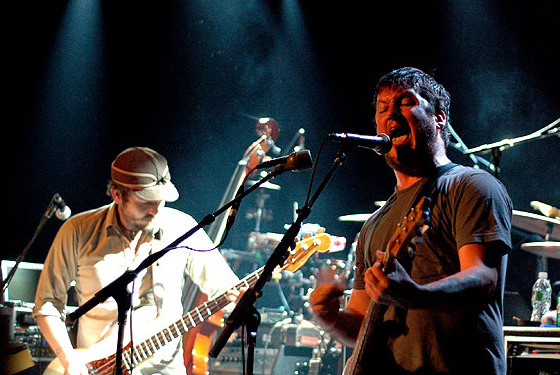
Secret Machines (the loudest band I've seen this year, but in many ways the best)

Wednesday, 2 December 2009

The music industry holds its breath...Craig speaks..!


So as we skip nonchalantly to the end of the ‘Noughties’, maybe it’s about time that I did what the cool people are doing, as well as Q and NME, amongst others, and “publish” my preferred ten albums of the decade. So, in no particular order:

1. The Strokes – Is This It (2000)
2. Arcade Fire – Funeral (2004)
3. Modest Mouse – Good News For People Who Love Bad News (2005)
4. Interpol – Turn On The Bright Lights (2002)
5. Arctic Monkeys – Whatever People Say I Am, That’s What I’m Not (2005)
6. The Killers – Hot Fuss (2005)
7. Bloc Party – Silent Alarm (2005)
8. Elbow – The Seldom Seen Kid (2007)
9. Radiohead – In Rainbows (2007)
10. Mogwai – Mr. Beast (2006)

I was listening to The Strokes’ first album on my way home from work today. ‘This Is It’ is one of those albums that hasn’t been on my Ipod for a long time, sits in a CD case on the shelf, and rarely makes it into CD player. However, when it does my love and respect for this album is renewed, every time. It’s easy to say that it sounds like all of the other ‘trendy indie’ that’s around at the moment, but the truth is, The Strokes reinvented the genre – at least in its current guise. It’s the earliest album on my list; released in the year 2000 when I, admittedly, was more interested in bands like Limp Bizkit, Linkin Park and The (reasonably more redeemable) Defrtones and System of a Down. At the height on ‘Nu-Metal’ it’s hard to remember what a refreshing sound The Strokes were producing.

Now there are thousands of bands who sound like The Strokes and, I think, music is much better in 2009 than it was in 2000. Part of this is also down to the Arctic Monkey’s debut. This is one of two albums that I say (and others will perhaps also say…) sums up the whole university experience for me. Between 2004 and 2007 it was ‘Whatever People Say I Am, That’s What I’m Not’ and ‘Hot Fuss’ by The Killers which were heard on pretty much every nightclub stereo in Manchester and elsewhere up and down the country. Now I realise that Mr. Brightside is an overplayed track, but that doesn’t get away from the fact that it is an awesome song. Furthermore, all of the other songs on the album, some of which I’ve seldom heard on anything other than my Ipod, are incredibly good.

“Funeral” by the Arcade Fire is perhaps one of the most mesmerising albums that I have ever heard. Radiohead produced an album that rivals OK Computer in its scope and ambition and “The Seldom Seen Kid” rightly wrested the Mercury Music Prize from the soon-to-be ‘has beens’ who would sooner rely on image than produce anything of real musical integrity.

Modest Mouse have slowly become my favourite band this year. I have been working my way through their back catalogue these past few months and will be seeing them live at the Manchester Ritz next month. They are one of four US bands in my selection of ten. One is Canadian and five are British. This goes against the argument of an American friend who claims that the 1990s were the decade of the British band, whilst the ‘Noughties’ have been the decade of US music. To some extent I agree with him, however considering the fact that ‘Hot Fuss’ cites New Order as a major influence, ‘Turn on the Bright Lights’ would not have appeared had it not been for a reasonably famous late 1970s Manchester band called Joy Division and ‘Good News For People Who Love Bad News’ follows in the best traditions of British indie music, the claim becomes hard to sustain. All are truly great albums, produced by American artists; however, in my opinion, ‘This Is It’ is the only true, great ‘American album’.

Bloc Party deserve a mention; whilst their subsequent albums have been rather disappointing, ‘Silent Alarm’ is a great post-punk album with a bouncy indie twist. ‘Turn on the Bright Lights’ is a brilliantly dark and disturbing album and Mr. Beast proves that you don’t have to sing over the tracks in order to make a truly great record.

I don’t think this list is too pretentious! All of the albums you’ll recognise, people play them a lot – but that’s because they’re good, really good.

Monday, 16 November 2009

The Sun. Film. Masters degrees


I thought I’d start by weighing in on the ‘Jacqui Janes’ saga of last week. After all, I love nothing more than bashing The Sun. The background to this story is the death of Mrs. Janes’ son, Jamie, who was killed in Afghanistan recently. Since the Falklands War, Prime Ministers have followed the convention of writing individually to the families of the bereaved. This is understandable given the fact that we no longer seem to fight wars where inordinate numbers of troops are killed. Don’t get me wrong, a single death is one too many; however, during wars past when thousands have perished, it has been customary for impersonal telegrams delivered by the postman to convey the awful news. The MOD can today however contact individual families literally hours after a soldier has died, and this is usually done in the form of a chaplain and a military officer who visit the bereaved family in person. Letters from the PM follow soon afterwards.

Brown will have been sitting at his desk on many an evening these past few months writing letters to the families of the 230+ service personnel who have received news of the ultimate sacrifice. These letters are handwritten which can’t be easy for a man who is blind in one eye and, rumour has it, is slowly going blind in the other. Therefore, imagine my surprise (or lack of, they do stoop pretty low!) when The Sun used the memory of a dead soldier to exploit a bereaved mother in order to smear Gordon Brown. It must not be forgotten that the paper changed its allegiance to the Conservatives about a month ago. Imagine their glee when an understandably upset Mrs. Janes contacted them about the hastily scrawled letter. I can just see the exchange – “Well that’s awful about the poor soldier Mrs. Janes, but…erm…IMAGINE how we can use this to really nail Brown. May we publish your letter?’ Using a dead solider as a way to score cheap political points is indefensible, and that’s all I have to say on the matter.

I was saddened today to hear of the death of Edward Woodward. To many, including me, he is most famous for his portrayal of the high Anglican policeman sent to a remote Scottish island in the film ‘The Wicker Man’. Made in 1973, it has always set the standard for British horror films. With little or no use of blood and a building tension, the film seems to tap into our greatest fears about paganism, the occult and sheer helplessness. I’ve often watched the end of the film and wished, or hoped, that the Sgt. would be rescued by the authorities; I’ve thought similar thoughts when watching Steve McQueen vault barbed-wire fences but that’s by the by... All in all, it’s one of the best films this country has ever produced, helped along by a mesmerising performance by the late Woodward and shocking in terms of its imagery and power of suggestion. In fact, I may just go and watch it this week.

In terms of film, my subscription to Lovefilm is coming along nicely. Recently I’ve watch Amelie, Notes on s Scandal, The Shipping News, Hot Fuzz and Milk. Waiting on my desk is Katyn, a film about the Soviet slaughter of Polish troops in the eastern part of the country in 1940. This act of mass murder was covered up once the Poles and Russians became ‘allies’ after 1941 and has only recently, through testimony, been fully explained and accounted for (although the Russians have not necessarily been gushing in their apologies).

Whilst we’re on the subject of genocide and mass murder, my Masters application for Holocaust Studies has finally been sent to the University of Manchester. It’s all feeling very real now. I went into the University over half term to discuss the practicalities of studying for the course part time whilst still remaining in a full time job. The prospects look good; over two years I can expect to be in university no more than three hours a week and the tiny number of students on the course (there are currently five) means that seminars are planned to times that suit everyone. My application was sent electronically the other day. Now I need to wait to see whether I have been successful before I can apply to the various Jewish organisations (kindly researched by HET) for funding. The university should also be able to help there too. Watch this space.

Tuesday, 20 October 2009

Question Time

Dear David,

I support you in the BBC's decision to accept Nick Griffin on to Question Time. Only in a public forum where sensible debate is held can we hope to destroy the hate-filled claims of the BNP.

I support neither Labour nor the Conservatives. Yet I know that both parties have a range of talented parliamentarians who, through the subtlety of their argument, will be able to rip into the BNP's message more effectively than the bottles thrown by the UAF hope to achieve.

(In this case, Baroness Warsi and Jack Straw are good choices - however I would like to see Bob Marshall Andrews because he'd turn Griffin into mincemeat!)

The BNP now have European seats. They need to be dealt with head on - on our terms (sensible debate), rather than theirs (violence and protests - doesn't this feed their propaganda machine?). My passionate hope it that Griffin and his party are made to look like a bunch of fools on Question Time. And I think they will be. Their arguments rest on suspicion and lies, and this is no substitute for what is right and good.

If we defeat them honestly with WORDS Griffin et al can no longer claim that they are the victim of a Liberal Conspiracy - rather, he will be a victim of the TRUTH! Surely the party will then lose its raison d’etre.

At present I do not believe that the Unite Against Fascism gets to the shaky heart of the BNP's message. Yes, protests are effective but to what extent do they challenge the party's policies? This should be very easy to do on television.

Mug the BNP of their right to free speech and we may have no reason to distrust them. Allow them to speak, and in the words of JS Mill, 'truth will prevail'.

'I may not agree with what you have to say but I will fight to the death for your right to say it'
Voltaire


Craig Owen
Writing in relation to a request made by ‘Hope not Hate’
http://www.hopenothate.org.uk/index.php

PS - I really do hope you send this guys

Sunday, 4 October 2009

Vote for a Change (rather than moan about the Tories?)


Today I went to a meeting chaired by ‘Vote for a Change’ at the Friend’s Meeting House in Manchester; a mere stones throw away from the Tory party conference at the G-Mex. I first came across this group when my 6th formers hijacked a protest organised by themselves and Peter Tatchell on College Green in Westminster. The group has two aims – 1. To replace the ‘first past the post’ electoral system with one that is more democratic, accountable and breaks apart the majoritarianism of British politics, and 2. Bring about a revolution in British politics in the wake of the expenses scandal. Delegates want to see an end to the so-called ‘Westminster Gravy Train’ and a return to real MP accountability.

Daniel Hannan, for example, argued that at the moment MPs in safe seats (he calls them “modern ‘pocket boroughs’”) are accountable only to whips who can have them deselected at election time should they fail to ‘toe the party line’. He argued for the abolition of safe seats (i.e., other PPCs can challenge you to your candidature) and for Primaries (recently trailed by the Tories in Totnes) to be rolled out across the country.

The associate editor of the New Statesman, whose name I forget, argued vociferously against Primaries by pointing out that the Totnes experiment cost £38,000, a sum that the Tory party isn’t likely to want to spend again. He also poured cold water on any hopes of the Conservative party cleaning up politics if and when they are elected. He said that the party came out worst from the expenses scandal and Cameron meted out punishments according to individuals’ usefulness to the ‘government in waiting’. In other words, backbenchers like Steen were forced to fall on their sword whilst not one member of the front bench was disciplined. Only Alan Duncan lost his job when he was recorded saying that MPs were forced to live on rations. Needless to say, Duncan is a millionaire.

Martin Bell, another speaker in this incredibly diverse bank of speakers (I can’t imagine that these people have all been in the same room together ever before) said that Labour won in 1997 off the back of Tory sleaze and have spent the best part of the last 12 years managing to replicate many of the Tory misdeeds. John Strafford holds a role within the Chairmanship of the Tory Party (I can’t remember which) and he actually impressed me most. He offered a convincing and accurate argument against the FPTP (when many in his own party are happy to keep it as it is – after all, it will probably return them to government next year) and seemed upbeat about the prospects for change, at least until Mr. Hassan (New Statesman) ‘urinated on his bonfire’. Lewis Baston of the Electoral Reform Society said that bribery and disenchantment were nothing new in politics, the only difference was that today the two parties have a lot less support that they used to enjoy – nevertheless, power still swaps between these two elites in our democratically questionable majoritarian system.

Polly Toynbee chaired proceedings. She did a brilliant job of appearing impartial despite the musings of Daniel Hannan, Conservative MEP and darling of the American right wing media for his statements that he ‘wouldn’t wish the NHS on anyone’. I hadn’t expected this to come up – we were having a debate about political renewal after all, and it seemed as though Hannan was reasonably articulate in his observations of our political system and offered a few decent arguments, albeit without much support from the left leaning members of the panel, Hassan, Toynbee et al.

And then something happened which made me think ‘right, Labour have really lost the election’. A member of Manchester Young Labour sitting behind me (who I’d recognised from our meeting with the Health Secretary) asked when proceedings were opened up to the floor if there’s any real choice next year when members of one party come out with spurious comments such as Hannan’s on the NHS. I had a problem with this for several reasons:

1. Hannan’s recent notoriety is down to his irksome views on national health, However, that’s not why he was there – he was talking about changing the political system and was making some reasonably decent points (for a hard right Tory MEP)
2. The girl who asked the question showed her disdain for Hannan by playing with her phone and not looking up when she was asking the question and during his answer.

MYL clearly came to the meeting with the intention of scoring some political points despite the fact that ‘Vote for a Change’ had aimed to have a frank and nonpartisan discussion about our broken political system. One of the things that has persuaded me that active involvement in the Labour party is perhaps ‘not my thing’ is that I’m getting increasingly pissed off by those annoying minor apparatchiks who are so wedded to the party, so blindly faithful to everything it stands for that they end up criticising everyone but themselves. What the young lady hoped to achieve by asking an off topic question at a public meeting is open to debate. Labour needs to question its own record – it has been in power for 12 years now. There are still those who prefix every sentence with ‘Before 1997…’ We need to start talking about ‘Since 1997…’ Numerous commentators, including Toynbee, argue that Labour is crap at talking about its successes. Even the Spectator is so confident of a Tory victory that it has started to talk about the good stuff that Blair did. However, to return to this little stunt in the Friend’s Meeting House, it represented in microcosmic form everything that has become so pathetic about the Labour party. It is tantamount to a KO’d boxer blithely still trying to throw limp wristed punches when flat on his back on the canvas because he has to be seen to be still putting up a fight. It was ill-informed, pointless and depressing to hear for people like me who like to think that there is life in the old dog yet. Labour needs a cleansing period out of office, that’s when groups like MYL will really come into its own and, I hope, find the ability to attack the Tories on less superficial lines.

That being said, the Vote for a Change meeting was interesting and informative. Conservative party conference in Manchester? Next Ethiopia will be hosting Live Aid for us….

Thursday, 1 October 2009

Why I won't lose sleep over The Sun's political alliegence


The Sun is like a chameleon. Just like this creature changes its colours to match surroundings, this 'news'paper changes its stripes to match the political landscape. Indeed, whatever claim that the paper had in being able to dictate public opinion has now clearly gone. Today it merely follows in the wake of the changing tide, dutifully preaching to an already converted majority.

In 1992, The Sun famously printed the headline 'If this man [Kinnock] is elected tomorrow, will the last person to leave Britain please turn off the light?' In 1997, they switched sides with the notably less imaginative headline 'The Sun backs Blair!' and yesterday it claimed that 'Labour's lost us'. The paper loves to back a winner, in fact I'm sure that it's written in the paper's rule book that it has to pick the right time before any election when the outcome can be reasonably predicted to choose its party. Incredibly unprincipled I know, but this is a paper which is blatantly homophobic, ruins lives by referring to people as 'paedos' before they are convicted of any offence and contributes no end to Islamophobia and other types of xenophobia. You've got to ask yourself why any well meaning party would want to support of this toilet paper?

For a long time the answer has been clear. The Murdoch-owned paper is one of Britain's most read dailies. Its simple language makes it accesible to the almost anyone (I think the required reading age is about 7) and, yes, it has an uncanny abiity to predict election winners. I wonder why that is! Unfortunately for the Sun, however, its ability to control public opinion is on the wane. The age of 24 hour news coverage and the internet has seriously reduced its impact. No well meaning individual would go to their website for their daily dose of news. All newspapers are suffering, however it seems that The Sun's illiberal, bawdy and tawdry sensations are particularly out of kilter with the modern consensus. The internet has given us the ability to blog about issues such as this. The Sun no longer controls the agenda or seems to sum up the public mood (as it did with 'Gotcha' http://barorny.com/archives/gotcha1.jpg), it trails in its wake.

Yesterday, Cabinet members were rightfully angry, not about the switch, but rather The Sun's cruel timing. It took the limelight from a buoyant and promising Labour conference. That's all the paper can do nowadays - pick the right time. After all, it has lost its 'voice of the nation' moniker. By getting in bed with an old Etonian it has proved itself to be one of society's biggest hypocrites. Watch out Dave, give it a few years and you'll be splashed across the front page when the party has had enough of you - or smells another winner...it never fails to back one you know!